











Waclawiczek A, Leppä AM, Renders S, Bergerweiss I, Stumpf K, Betz B, Gabrowski S, Huang FY, Lalioti ME, Hempel B, Sohn M, Kuusanmäki H, Thiel V, Unglaub JM, Shahswar R, Richter S, Janssen M, Karpova D, Donato E, Bonig H, Röllig C, Raffel S, Heuser M, Hundemer M, Kontro M, Eisfeld AK, Sauer T, Cabezas-Wallscheid N, Müller-Tidow C, Trumpp A.
Cell Stem Cell. 2026 Jun 4;33(6):982-999.e8.
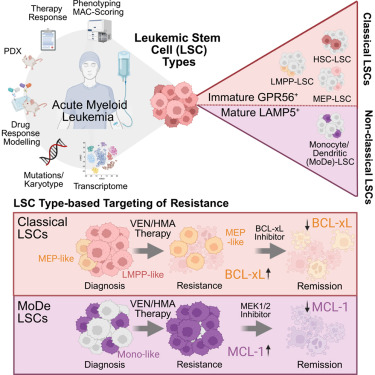
The BCL-2 inhibitor venetoclax has transformed the treatment of acute myeloid leukemia (AML), but relapse due to resistance of leukemic stem cells (LSCs) remains a major challenge. By molecular and functional profiling of LSCs from >150 patients, we identify four LSC subtypes. These mirror distinct hematopoietic lineage stages, which determine the expression ratio between the venetoclax target BCL-2 and resistance-inducing proteins MCL-1 and BCL-xL (MAC-score). Longitudinal analyses reveal that venetoclax resistance mostly arises in LSCs through plasticity toward a megakaryocytic/erythroid-progenitor (MEP)-LSC state that switches survival dependency from BCL-2 to BCL-xL. In rare cases, mature monocytic/dendritic (MoDe)-LSCs, found within LAMP5+ monocytic AMLs, drive venetoclax resistance. LSC subtyping improves genetic risk stratification and provides subtype-specific therapies: venetoclax-resistant MEP-LSCs respond to BCL-xL inhibitors, whereas MoDe-LSCs are sensitive to MEK1/2 inhibition. Our findings reveal four distinct LSC types with unique vulnerabilities and propose biomarker-guided treatment strategies that complement genetic profiling to overcome venetoclax resistance.