










Dawn S Lin, Isabell Alexandra Guckes, Ian Ghezzi, Pia Sommerkamp, Esther Rodríguez-Correa, Enrico Frigoli, Santiago Cerrizuela, Lukas P M Kremer, Sina Bergemann, Nesrine Aroua, Frank Y Huang, Patrick Stelmach, Andreas Narr, Mari Carmen Romero-Mulero, Petra Zeisberger, Markus Sohn, Simon Anders, Marieke A G Essers, Nina Cabezas-Wallscheid , Ana Martin-Villalba, Michael D Milsom, Maria C Puschhof, Andreas Trumpp
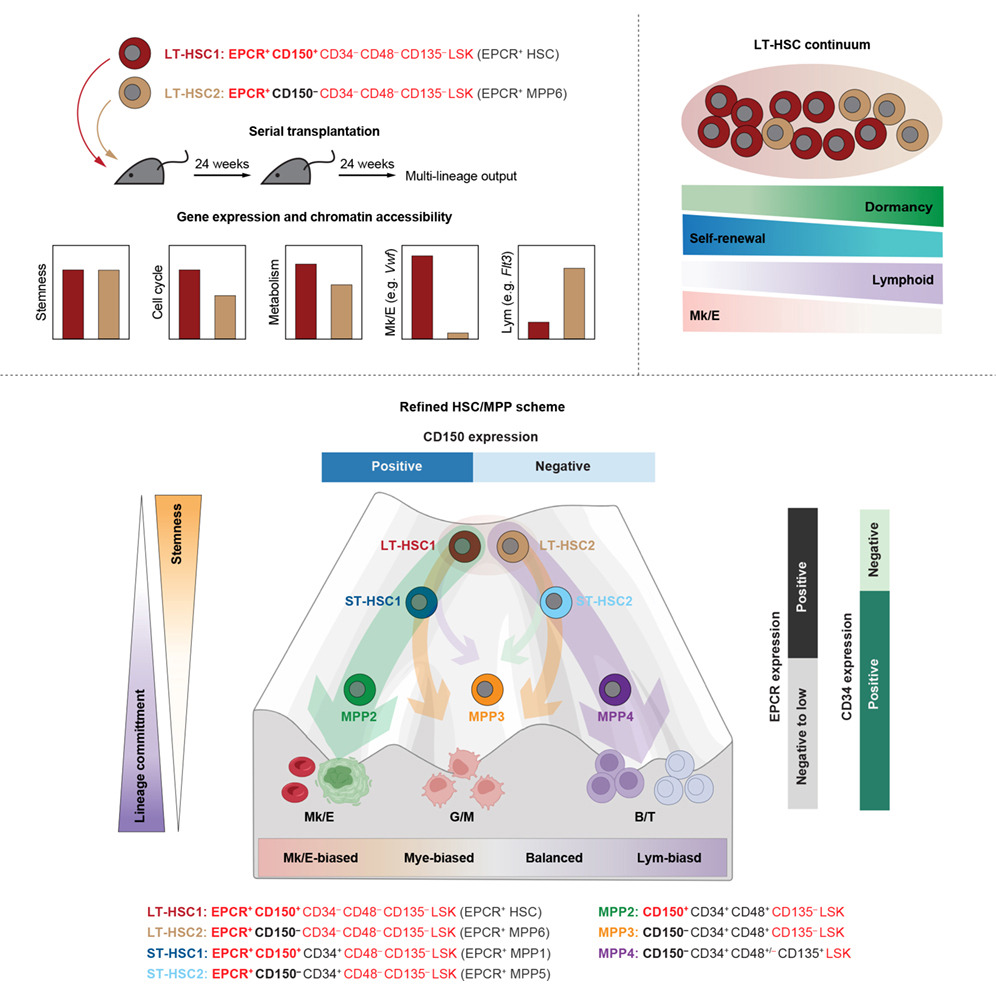
Cell surface expression of the Slam family member CD150 is widely used for the prospective isolation of multipotent long-term hematopoietic stem cells (LT-HSCs). Here, we identify a bona fide endothelial protein C receptor (EPCR)+CD150- HSC subset, termed LT-HSC2, that sustains serial multi-lineage reconstitution. Long-term label-retaining assays reveal that LT-HSC2s are more deeply dormant than conventional EPCR+CD150+ LT-HSC1s, exhibit reduced cell cycle activation in response to inflammatory stress, and preserve stemness for prolonged periods in vivo. Moreover, combining EPCR with established HSC and multipotent progenitor (MPP) markers resolves the earliest stages of lineage divergence toward megakaryocytic/erythroid-biased CD150+ and lymphoid-biased CD150- trajectories. Thus, EPCR expression in HSCs and MPPs is associated with increased stemness, whereas CD150 expression does not encompass the full spectrum of long-term repopulating HSCs. Our findings establish EPCR+CD150- LT-HSC2s as a distinct, exceptionally dormant stem-cell subset and reveal an additional layer of HSC heterogeneity governing self-renewal, decreased stress sensitvity. and earliest lineage priming.
Link: https://www.sciencedirect.com/science/article/pii/S1934590926003802?via%3Dihub