
He has been awarded a DKFZ International Graduate School fellowship to fund his PhD studies within the lab. Ian will join the group from Italy in the summer of 2021 and will study the effect of interferon therapy on dormant malignant stem cells in the setting of JAK2-mutated myeloproliferative neoplasms.
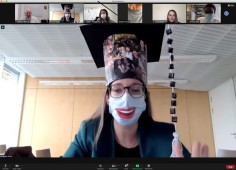
Congratulations to Megan, our latest PhD student to graduate from the lab. After an outstanding performance at her virtual defense, we had a virtual celebration spanning three continents (taking social distancing to a new level). Megan studied the mechanisms through which hematopoietic stem cells acquire genomic mutations during aging, and during the course of her studies presented her work at several international symposia.
Congratulations to Esther Rodriguez, who has been awarded a DKFZ International Graduate School fellowship to fund the duration of her PhD research project in the group. Esther's PhD. project will be focused on assessing HSC functional potential using single cell transplantations in combination with mathematical modeling, which forms part of a collaboration with the group of Prof. Thomas Höfer, also at the DKFZ.
Congratulations to Dr. Susi Lux, whose abstract "Genetic rescue of of Fanca-/- HSPCs with Evi-1 overexpression suggests a mechanistic link with DNA damage response" has been accepted as an oral presentation at the forthcoming European School of Hematology Translational Research Conference: "Bone Marrow Failure Disorders - from the cell to the cure of the disease". The conference will take place on a virtual platform from the 13th to the 15th of November.

New work from the Milsom lab now available on bioRxiv "Hematopoietic stem cells fail to regenerate following inflammatory challenge."
Citation:
Ruzhica Bogeska, Paul Kaschutnig, Malak Fawaz, Ana-Matea Mikecin, Marleen Buechler-Schaeff, Stella Paffenholz, Noboru Asada, Felix Frauhammer, Florian Buettner, Melanie Ball, Julia Knoch, Sina Staeble, Dagmar Walter, Amelie Petri, Martha J Carreno-Gonzalez, Vinona Wagner, Benedikt Brors, Simon Haas, Daniel B Lipka, Marieke A.G. Essers, Tim Holland-Letz, Jan-Philipp Mallm, Karsten Rippe, Paul S Frenette, Michael A Rieger, Michael D Milsom
Hematopoietic stem cells fail to regenerate following inflammatory challenge.
bioRxiv 2020.08.01.230433; doi: 10.1101/2020.08.01.230433
Abstract:
Hematopoietic stem cells (HSCs) are canonically defined by their capacity to maintain the HSC pool via self-renewal divisions. However, accumulating evidence suggests that HSC function is instead preserved by sustaining long-term quiescence. Here, we study the kinetics of HSC recovery in mice, following an inflammatory challenge that induces HSCs to exit dormancy. Repeated inflammatory challenge resulted in a progressive depletion of functional HSCs, with no sign of later recovery. Underlying this observation, label retention experiments demonstrated that self-renewal divisions were absent or extremely rare during challenge, as well as during any subsequent recovery period. While depletion of functional HSCs held no immediate consequences, young mice exposed to inflammatory challenge developed blood and bone marrow hypocellularity in old age, similar to elderly humans. The progressive, irreversible attrition of HSC function demonstrates that discreet instances of inflammatory stress can have an irreversible and therefore cumulative impact on HSC function, even when separated by several months. These findings have important implications for our understanding of the role of inflammation as a mediator of dysfunctional tissue maintenance and regeneration during ageing.