
Esther Rodríguez-Correa, Florian Grünschläger, Tamar Nizharadze, Natasha Anstee, Jude Al-Sabah, Vojtech Kumpost, Anastasia Sedlmeier, Congxin Li, Melanie Ball, Foteini Fotopoulou, Jeyan Jayarajan, Ian Ghezzi, Julia Knoch, Megan Druce, Kleo Aurich, Marleen Büchler-Schäff, Susanne Lux, Pablo Hernández-Malmierca, Julius Gräsel, Dominik Vonficht, Marta López-Osias, Elvira González-Saiz, Daniel Fernández-Pérez, Anna Mathioudaki, Judith Zaugg, Alejo Rodríguez-Fraticelli, Ralf Mikut, Andreas Trumpp, Thomas Höfer, Daniel Hübschmann, Simon Haas, Michael D Milsom
Nature Cell Biology, 2026 May 25 doi: 10.1038/s41556-026-01958-0
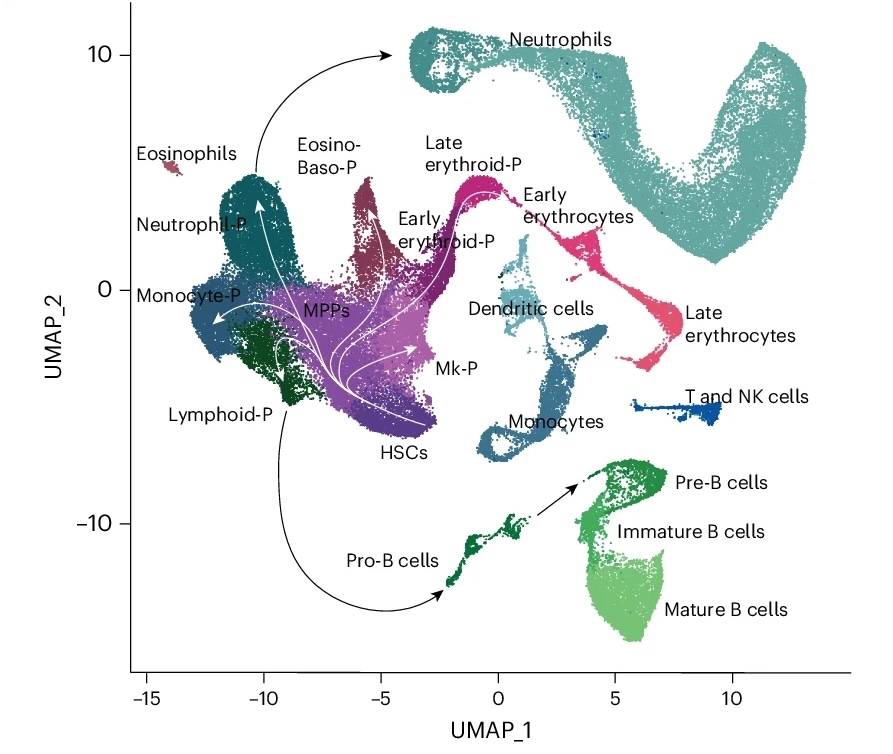
Haematopoietic stem cells (HSCs) display extensive molecular and functional heterogeneity. However, a cohesive model that explains the relationship and biological relevance of these diverse HSC states remains elusive. Here, by performing single-cell transplantations of over 1,000 highly purified murine long-term HSCs combined with in-depth phenotyping of their clonal progeny, we define kinetics-based reconstitution parameters which aligned HSCs into a single hierarchical trajectory reflective of functional potency. This approach revealed that previously identified lineage biases are actually transitory states along this linear trajectory, not a discrete stable condition. Single-cell secondary transplantations validated hierarchical ordering based on reconstitution kinetics, whereas mathematical modelling combined with experimental modulation of lineage-biased blood production revealed that apparent lineage-biased outputs actually arise from cell-extrinsic feedback regulation and clonal competition between slow- and fast-engrafting clones to fill mature lineages to their compartment size limit. This study reconciles multiple layers of HSC heterogeneity into a unifying framework.