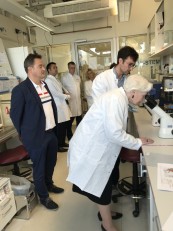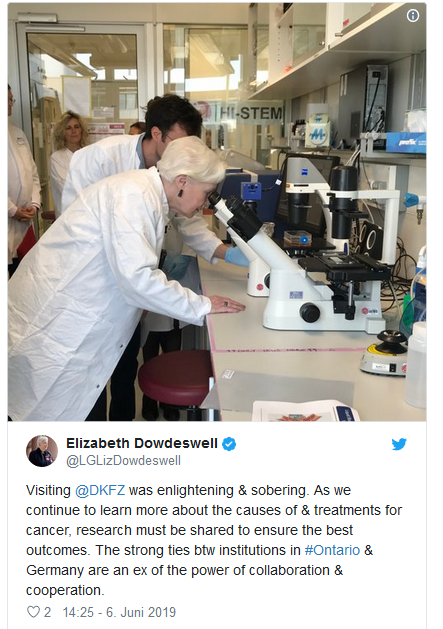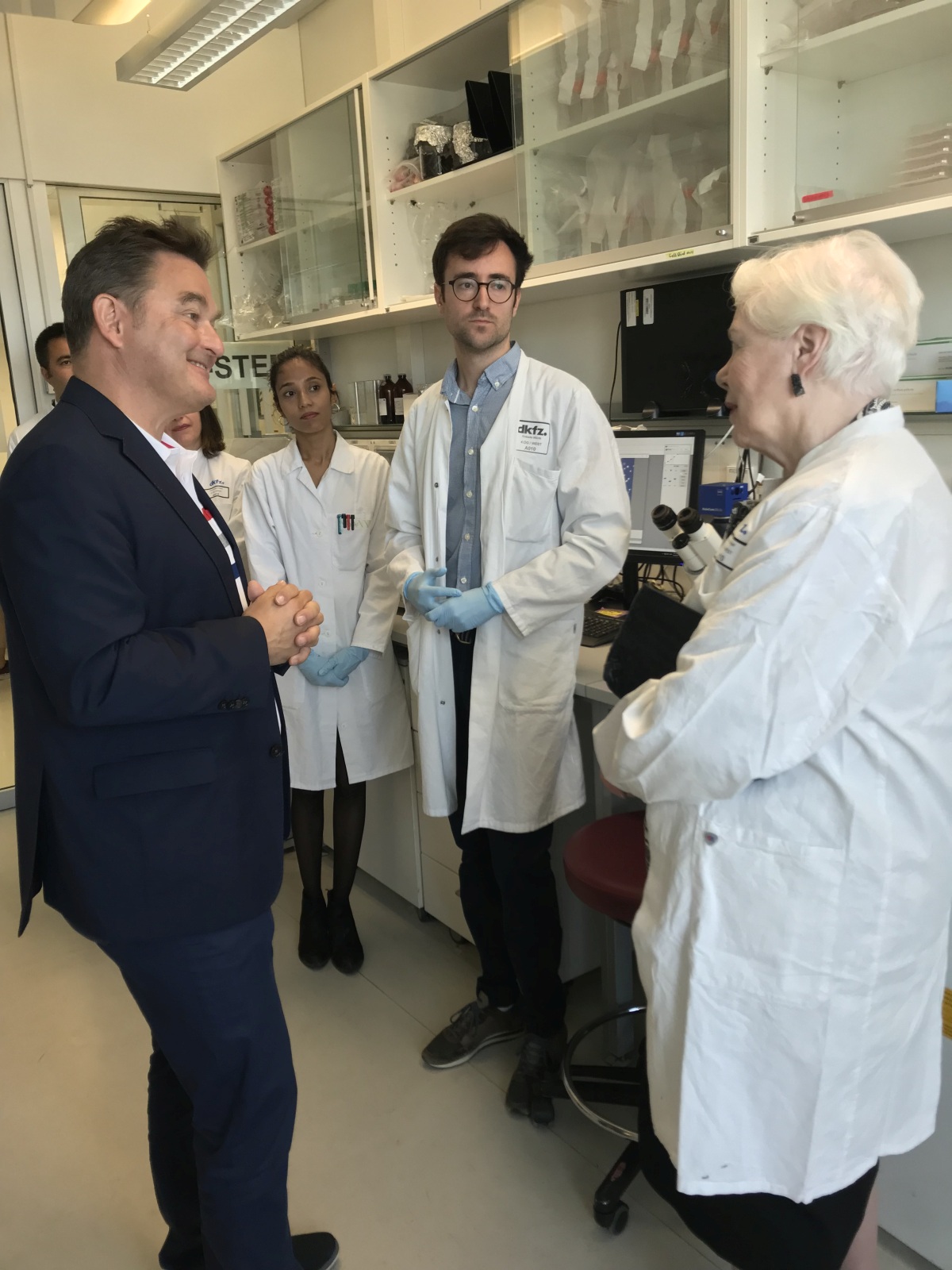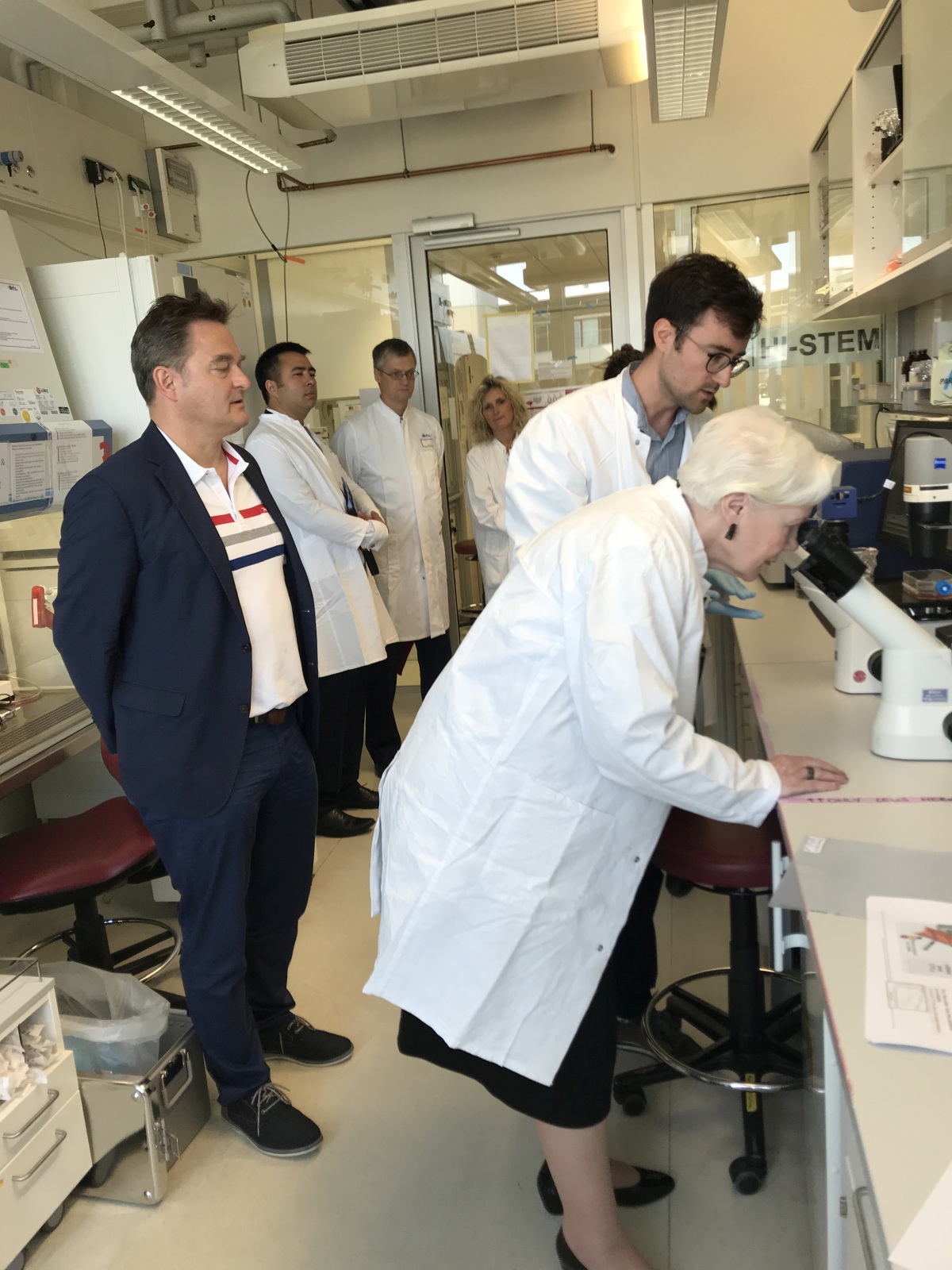
On June 4th, as part of her visit of the DKFZ, her Honour Lieutenant Governor of Ontario Elizabeth Dowdeswel (@LGLizDowdeswell) visited the HI-STEM Lab. As part of her tour she showed great interest in our research on the role of stem cells in cancer.


https://twitter.com/LGLizDowdeswell

https://twitter.com/LGLizDowdeswell

Elizabeth Dowdeswell and Andreas Trumpp

Elizabeth Dowdeswell and Andreas Trumpp

Elizabeth Dowdeswell in the HI-STEM Lab

Elizabeth Dowdeswell in the HI-STEM Lab

Based on an ongoing collaboration between HI-STEM and the German Biotech Company Miltenyi Biotec GmbH, our cell-culture medium for tumor cells from the pancreas is now available for sale at Miltenyi. The medium is an improved version of the one described in our Nature Medicine Paper (Noll et. al., Nature Medicine 2016) and allows the reliable expansion of tumor cells from primary or xenotransplanted human pancreatic tumor samples.

For more information visit the product page at Miltenyi, have a look at their application page or download the flyer.

We at HI-STEM are glad that our methods are now accessible for more researchers with the advantage of a quality controlled medium production.

Further Information:

  • Pancreas TumorMACS Medium at Miltenyi
  • Read our news article on the publication from 2016: Mechanism of therapy resistance in pancreatic cancer uncovered
  • Read the paper: Noll, E.M., Eisen, C., Stenzinger, A., Espinet, E., Muckenhuber, A., Klein, C., Vogel, V., Klaus, B., Nadler, W., Rosli, C., Lutz, C., Kulke, M., Engelhardt, J., Zickgraf, F.M., Espinosa, O., Schlesner, M., Jiang, X.Q., Kopp-Schneider, A., Neuhaus, P., Bahra, M., Sinn, B.V., Eils, R., Giese, N.A., Hackert, T., Strobel, O., Werner, J., Buchler, M.W., Weichert, W., Trumpp, A., & Sprick, M.R. (2016). CYP3A5 mediates basal and acquired therapy resistance in different subtypes of pancreatic ductal adenocarcinoma. Nature Medicine, 22(3), 278-287. doi: 1038/nm.4038
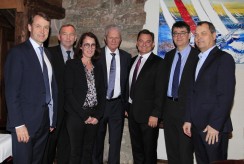
The HI-STEM Founding Team celebrates ten years of successful cooperation: Friedrich von Bohlen, Managing Director dievini Hopp BioTech Holding, Josef Puchta, Administrative Director DKFZ, Heike Bauer, Head Dietmar Hopp Stiftung, Dietmar Hopp Founder and Managing Director Dietmar Hopp Foundation, Andreas Trumpp, HI-STEM Managing Director, Michael Baumann, DKFZ Managing Director, Christof Hettich, Co-Managing Director dievini Hopp BioTech Holding (from left to right) | © Stefan Hebling

Ten years ago, HI-STEM, the Heidelberg Institute for Stem Cell Technology and Experimental Medicine, started its work within the newly renovated labs of the German Cancer Research Center (DKFZ). On the occasion of this anniversary, the founders have drawn a balance: Researchers at HI-STEM could proof for multiple cancer types how stem cells play a role during initiation, progression and therapy resistance of malignant tumors. The work of HI-STEM, which has been published in high-profile publications, has indicated new approaches for a more targeted and effective treatment of this devastating diseases.

In 2008, the DKFZ and the Dietmar Hopp Foundation joined forces to establish HI-STEM as a non-for-profit public private partnership. This concept of collaboration between academic research and a private organization was at that time highly innovative. “We are very grateful to all who contributed to the foundation of HI-STEM ten years ago. Especially we want to thank Dietmar Hopp and his foundation as well as the Management Board of the DKFZ for their extraordinary and sustained support.” says HI-STEM Managing Director Andreas Trumpp, who also acts as division head at the German Cancer Research Center.

Further Information:

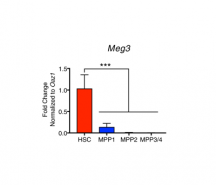
In this study, we have addressed the role of the imprinted long non-coding RNA (lncRNA) Meg3 and its associated miRNA cluster for adult hematopoietic stem cell (HSC) function. Meg3 is highly and specifically expressed in adult HSCs, but not in progenitor or mature cells. HI-STEM PhD student Pia Sommerkamp and her colleagues could show that targeted Meg3-deletion surprisingly does not impair HSC function or hematopoiesis. The effects of Meg3 deficiency were not only analyzed under homeostatic conditions, but also in response to inflammatory signaling and in in vivo serial reconstitution assays. Within the study, the team has shown that loss of Meg3 expression in HSCs in adult mice as well as in the embryonic stage does not affect the hematopoietic system. These results challenge a recent report and suggest that the Meg3 locus only indirectly affects HSC function by modulating the microenvironment or niches of HSCs.

The work was co-supervised by Andreas Trumpp from HI-STEM and Nina Cabezas-Wallscheid from the Max Planck Institute of Immunobiology and was published in Scientific Reports.

 Further Reading:

  • Sommerkamp, P., Renders, S., Ladel, L., Hotz-Wagenblatt, A., Schönberger, K., Zeisberger, P., Przybylla, A., Sohn, M., Zhou, Y., Klibanski, A., Cabezas-Wallscheid, N.@, & Trumpp, A.@ (2019). The long non-coding RNA Meg3 is dispensable for hematopoietic stem cells. Scientific Reports, 9(1), 2110. doi: 10.1038/s41598-019-38605-8


Subcategories