Solid Tumors and Metastasis

Solid Tumors, Metastasis & Therapy Resistance

Solid Tumors and Metastasis
Hematopoietic Stem Cells and Leukemia

Hematopoietic Stem Cells and Leukemia

Hematopoietic Stem Cells and Leukemia
Stem Cells and Tumor Microenvironment

Stem Cells and Tumor Microenvironment

Stem Cells and Tumor Microenvironment
HI-STEM Group Leaders

HI-STEM Group Leaders

HI-STEM Group Leaders
PlayPause
previous arrow
next arrow

Single-cell multiomics analysis reveals dynamic clonal evolution and targetable phenotypes in acute myeloid leukemia with complex karyotype

 Leppä AM, Grimes K, Jeong H, Huang FY, Andrades A, Waclawiczek A, Boch T, Jauch A, Renders S, Stelmach P, Müller-Tidow C, Karpova D, Sohn M, Grünschläger F, Hasenfeld P, Benito Garagorri E, Thiel V, Dolnik A, Rodriguez-Martin B, Bullinger L, Mrózek K, Eisfeld AK, Krämer A, Sanders AD, Korbel JO, Trumpp A. Nat Genet. 2024 Dec;56(12):2790-2803. doi: 10.1038/s41588-024-01999-x. Epub 2024 Nov 25.PMID: 39587361


Dawn S Lin, Isabell Alexandra Guckes, Ian Ghezzi, Pia Sommerkamp, Esther Rodríguez-Correa, Enrico Frigoli, Santiago Cerrizuela, Lukas P M Kremer, Sina Bergemann, Nesrine Aroua, Frank Y Huang, Patrick Stelmach, Andreas Narr, Mari Carmen Romero-Mulero, Petra Zeisberger, Markus Sohn, Simon Anders, Marieke A G Essers, Nina Cabezas-Wallscheid , Ana Martin-Villalba, Michael D Milsom, Maria C Puschhof, Andreas Trumpp

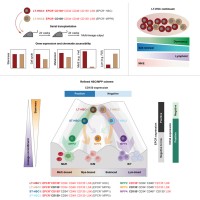
 Cell surface expression of the Slam family member CD150 is widely used for the prospective isolation of multipotent long-term hematopoietic stem cells (LT-HSCs). Here, we identify a bona fide endothelial protein C receptor (EPCR)+CD150- HSC subset, termed LT-HSC2, that sustains serial multi-lineage reconstitution. Long-term label-retaining assays reveal that LT-HSC2s are more deeply dormant than conventional EPCR+CD150+ LT-HSC1s, exhibit reduced cell cycle activation in response to inflammatory stress, and preserve stemness for prolonged periods in vivo. Moreover, combining EPCR with established HSC and multipotent progenitor (MPP) markers resolves the earliest stages of lineage divergence toward megakaryocytic/erythroid-biased CD150+ and lymphoid-biased CD150- trajectories. Thus, EPCR expression in HSCs and MPPs is associated with increased stemness, whereas CD150 expression does not encompass the full spectrum of long-term repopulating HSCs. Our findings establish EPCR+CD150- LT-HSC2s as a distinct, exceptionally dormant stem-cell subset and reveal an additional layer of HSC heterogeneity governing self-renewal, decreased stress sensitvity. and earliest lineage priming.


Link: https://www.sciencedirect.com/science/article/pii/S1934590926003802?via%3Dihub



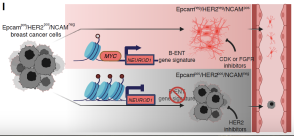
Neuroendocrine differentiation (NED) promotes lineage plasticity and therapy resistance in prostate and lung cancers. Here we identify NED as a route of treatment escape in breast cancer: neuroendocrine features emerged or increased in 22% of progressive cases, predominantly, but not exclusively, in HER2-positive subtype. Using patient-derived, epithelial/neuroendocrine organoid and xenograft models, we map the epigenetic and transcriptional divergence between epithelial and neuroendocrine states arising from a shared mutational background and define a breast cancer neuroendocrine signature. NED involves epigenetic silencing of EpCAM and amplified HER2, while NEUROD1 functions as a master transcriptional regulator of the neuroendocrine fate. NCAM-positive putative circulating tumor cells were detected in patients in whom EpCAM-based detection had failed. Neuroendocrine tumor cells exhibit an FGFR1 dependency associated with NCAM-FGFR1 interaction and mesenchymal FGFR1 splicing. Together, these findings establish NED as a mechanism of escape from HER2-targeted therapy in breast cancer, with implications for disease monitoring and intervention.